

By Dominik Haering
Less than one month after Hawaii became the 50th state of the United States, a tradition was born. On Sept. 20, 1959, the first Catalina Crossing outrigger canoe race was held. In original koa wood canoes, a Hawaiian All-Star team faced off against a California crew, paddling from Avalon to Newport Beach. After five hours on the water, Team Hawaii claimed victory. The Hawaiians returned home with a trophy, but California gained something lasting: a passion for outrigger canoeing that has only grown stronger over the decades.
Sixty-six years later, the race has changed and yet stayed the same. In 1959, koa wood canoes weighed hundreds of pounds, their massive hulls hewn from native Hawaiian trees. Today, canoes are built of carbon fiber and Kevlar, light enough for crews to lift with ease. Foam seats cushion paddlers, paddles are shorter and shaped for efficiency, and GPS trackers allow family and friends to follow the canoe’s exact position in real time. What has not changed is the spirit: six paddlers, one canoe, and the determination to cross the channel together.
A Legendary Course
Now recognized as the U.S. National Championship of outrigger canoe racing, the Catalina Crossing draws teams from across the mainland and beyond. On race morning, 71 crews lined up just off Newport Beach, stretching in a long line across the water. Teams traveled from the Bay Area, Lake Tahoe, Seattle, Maryland, Florida, Hawaii, Canada, and even Tahiti to take part. As Team Catalina paddled out of Newport Harbor to take their place on the start line, they were cheered on by other crews — a nod of respect for the island’s small but determined team. The Catalina Crossing is the final race of the OC6 series, and the camaraderie was as strong as the competition. At the blast of the horn, the canoes surged forward, bound for Avalon 26 miles away. The crossing takes about four to five hours — the same time as that very first race — and demands months of training. Crews must master not only paddling technique but also the art of seamless changeovers with the support boat, where paddlers leap in and out of the canoe in open water without losing momentum. It is a test of endurance, focus, and unity.
On Saturday, September 6th, women’s and co-ed divisions launched from Newport under bright morning skies. In the Women – Unlimited division, Dana Outrigger Canoe Club took the title in 3:54. In the Co-Ed – Open category, Newport Outrigger Canoe Club finished first at 3:50. The men’s competition resumed Sunday, September 7th, under calm, golden skies. Leading the Men – Unlimited division was Outrigger Canoe Club from Waikiki Beach, with a standout time of 3:47:47. These races showcased fierce competition and set an inspiring tone for the weekend.
The Island’s Team
For the Catalina Island Outrigger Canoe Club, the race carries unique meaning. To paddle from Newport across the channel is not simply a competition — it is a journey home. After a summer of training, the crew knew what awaited: swells rolling from the west, currents tugging unpredictably, and hours of relentless effort.
“You paddle for five hours, because that’s what it takes,” one team member explained. “But when you finally see the Casino in Avalon, it’s still a long stretch. That’s when you dig deepest.”
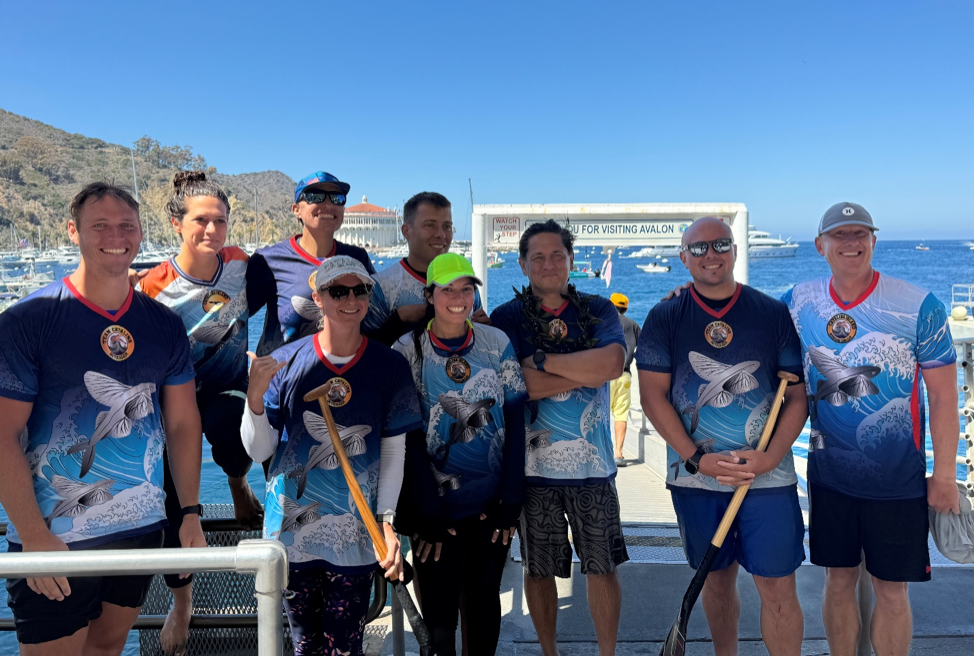
After four hours, fifty-three minutes, and forty-seven seconds — and multiple changes for every paddler — Team Catalina reached Avalon harbor on a beautiful summer day. It was a strong finish that honored months of preparation and the deep-rooted island tradition of outrigger paddling.
This year’s crossing also carried an added layer of meaning. It was the first Catalina Crossing without Charlie Canby, the club’s longtime chase boat captain. Charlie was more than a supporter of the team — he was a pillar of the Avalon community, known for his encouragement and abiding presence in island life. On the water and on shore, his absence was deeply felt, and many paddled with him in their hearts.
Then and Now
In 1959, spectators lined the beaches in Avalon to watch as koa canoes appeared on the horizon. The idea of paddling 26 miles across open ocean seemed daunting, even impossible, to many Californians. But the Hawaiian crew’s victory — and the California team’s determination — sparked a movement. Clubs soon formed up and down the coast, and outrigger canoeing became a beloved part of California’s coastal culture.
Today, the same anticipation fills Avalon’s harbor each September. Families, friends, and visitors gather on the seawall to watch as the first canoes appear, tiny specks growing larger with every stroke. Just as in 1959, the finish is greeted with cheers, relief, and celebration — proof that some traditions never lose their magic.
More Than a Race
Though the equipment has evolved, the essence of the Catalina Crossing remains unchanged. It is a race that honors history, demands unity, and embodies the timeless challenge of human strength against the sea.
“It’s about trust,” said a coach. “Trust in your crew, trust in the canoe, and trust in the ocean to let you through.”
An Invitation
For Catalina’s crew, the crossing is not just a race on the calendar. It is a homecoming across waters that define the island itself, guided by the same spirit that carried a koa canoe from Avalon to Newport 66 years ago.
The Catalina Island Outrigger Canoe Club welcomes paddlers of all ages, whether competitive or recreational. Practices are held Saturdays at 9 a.m. at Wrigley Stage. No experience is necessary — only a love of the water and a willingness to learn.
Let’s practice together for next year’s crossing?!