

By Dominik Haering
At dawn in Oceanside Harbor on August 23, the air buzzed with anticipation. Colorful canoes, long and narrow with paddles laid across their hulls, lined the beach and the steady rhythm of Polynesian drums filled the air along with the scent of sunscreen and salty ocean spray. Laughter rippled through the crowd as paddlers made last-minute checks on their canoes.
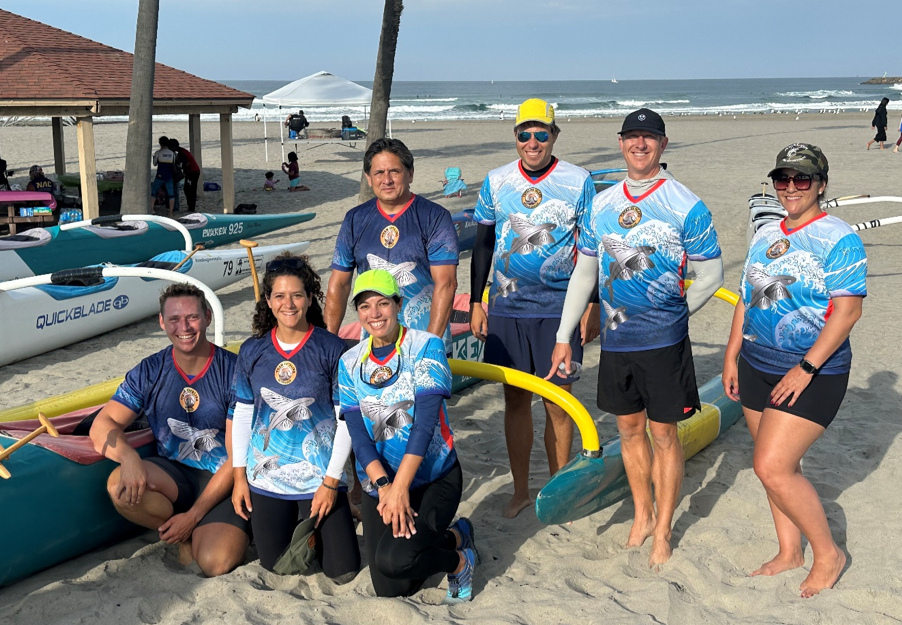
For the Catalina Island Outrigger Canoe Club, this was more than just another Saturday on the water. Seven men and women from the club had spent months preparing for the nine-person relay Paopao Outrigger Race. Named after the Samoan and Tuvaluan word for canoe, the Paopao is one of Southern California’s premier outrigger races, drawing 87 teams from around the country.
What made this day special for Team Catalina was not only the competition, but also the challenge. A traditional “change race” requires nine paddlers: six in the canoe, and three rotating in and out of the canoe while racing in the ocean. Catalina had only seven paddlers which meant longer paddling stretches in the boat, fewer breaks, and more fatigue.
A Cultural Tradition Alive at Sea
Outrigger canoeing has its roots deep in Polynesia, where seafaring people used canoes to travel thousands of miles across the Pacific. The ama, lashed to one side of the canoe, gave stability against swells and wind. Today, the sport has spread worldwide, but it remains deeply tied to its cultural origins. Before the race began, organizers gathered all teams for a pule — a Hawaiian prayer asking for safety on the ocean and respect for tradition.
“It’s always moving,” said Ernest Diaz, who was coach and steersman for the Catalina crew. “We’re not just racing; we’re part of something much bigger – an ancient tradition.”
The Start: Thunder, Lightning, and Adrenaline
As teams prepared to launch, a flash of lightning lit the sky, a roll of thunder delayed the start. But by 9 a.m., the clouds lifted, and the ocean, though restless, was ready. Canoes lined up just outside the harbor, paddles poised above the water. When the horn blew, the quiet was shattered by a roar of synchronized strokes, the ocean frothing white beneath 52 canoes of women and Co-Ed teams cutting seaward.
The course ran six miles straight out into the Pacific before bending left and tracing a triangular path back to the harbor. Team Catalina quickly found its rhythm, blades digging deep as the support boat cruised nearby. “The first few minutes, it’s all adrenaline,” said Grant Simington. “Then you settle in, and that’s when the real work begins.”
Battling Swells, Trusting the Team
The Pacific tested every canoe. Rolling swells slapped hulls sideways, and chase/support boats created confused wakes. Some teams flipped in a dreaded huli, their canoes capsizing and spilling all six paddlers into the ocean, but Team Catalina held steady.
Rotations came quickly. Paddlers leapt into the water, swimming to the chase boat as teammates propelled themselves into their seats. With only seven to share the load, Catalina’s paddlers stayed in longer and pushed harder than most. Muscles ached, lungs burned, but no one let up.
“Endurance races like this aren’t just about strength,” explained Dr. Meghan Zomorodi, a sports medicine physician at Catalina Island Health and paddler on the team. “Training smart, fueling well, and recovering on the go are key to optimizing sports performance. Even in the chase boat, you’re hydrating, stretching, and mentally resetting for the next turn. With only seven paddlers, those strategies—combined with efficiency, teamwork, and grit—kept us in the race.”
A Finish to Remember
After nearly three hours in the open ocean, Catalina’s canoe surged back toward the breakwater. Spectators lined the harbor wall, cheering as competing crews sprinted for the finish. At 2 hours and 56 minutes, Team Catalina crossed the line. “We went in knowing we’d be under pressure,” said one team member. “But we also knew it was about spirit, not just numbers.” Against teams with a full roster, they placed 7th in the Co-Ed Open division — a result that drew proud smiles all around.
“When we hit the finish line, all I could think was, ‘We did it,’” said Meghan. “We came here short-handed, and we proved to ourselves that teamwork can carry you further than numbers.”
Looking Ahead: The Catalina Crossing
The Oceanside race was more than just a test; it was a tune-up for what lies ahead. On September 6, the Catalina Island Outrigger Canoe Club will line up for the legendary Catalina Crossing, the 26-mile U.S. National Championship race from Newport Beach to Avalon. For the island crew, it’s more than a race — it’s a homecoming. For Kara of the Cadman family, one paddler of Team Catalina, the race carries a personal meaning. “Crossing the channel without a motor has been a goal of mine ever since I learned that my grandpa swam it and rowed it alone,” she said. “Racing the channel will be an adventurous way to get back home.”
Team Catalina will represent the island community with a Co-Ed crew racing from Newport Harbor to Avalon Casino Point on Saturday, Sept. 6. Everyone is invited to cheer the team over the finish line at approximately 1:30 p.m. and at the award ceremony at 3:45 p.m. at Wrigley Stage.
An Open Invitation
With 84 active or supporting members, the Catalina Island Outrigger Canoe Club is a mix of recreational paddlers, competitive racers, and newcomers eager to participate. What unites them all is the joy of being on the water, working in unison, and experiencing part of an ancient Polynesian culture. Practices are held on various days and every Saturday at 9 a.m. starting at Wrigley Stage. New paddlers are always welcome.
“Once you feel the canoe glide and hear six paddles hit the water together, you’re hooked,” said Aliana Gonzalez. “It’s not just exercise. It’s community, it’s culture, it’s connection. It’s Ohana.”
For Team Catalina, the Paopao race was more than a race. It was proof of resilience, tradition, and the deep bond between islanders and the ocean that surrounds them.