

Jim Watson is the author of Mysterious Island Catalina, available on Amazon and in stores in Avalon and Two Harbors.
There is something so vast and clean about the Pacific Ocean. Unlike its sister sea the Atlantic, with its green-hued waters and troubled shores, the Pacific spans nearly a third of the globe, interrupted only occasionally by enchanted islands with relaxed cultures, swimming-pool lagoons and clean-as-glass breakers pounding themselves into foam that glares bleached white, unlike the sickly yellow foam of the Atlantic.
But one thing that the Pacific Ocean does have in common with the Atlantic is the same disturbing tendency to spawn catastrophic and deadly storms. We know them as hurricanes in the Atlantic and typhoons in the western Pacific.
Such were the circumstances that led to an urgent email sent to me from the American Red Cross on July 1 of this year. Typhoon Bavi was headed towards that neck of the woods and looked like it was going to make trouble. The Red Cross needed volunteers to go there and I was to be one of them.
Nearly every other deployment I’ve been on with the Red Cross in the past 10 years has been in the sheltering department. But the hat I was going to wear this time was as a volunteer for Disaster Services Technology, or DST. These are the folks who handle the Information Technology of disaster responses, such as setting up cell phone and internet service and distributing smartphones and laptops to the other Red Cross departments so that they can communicate with each other and with the outside world.
Because of the exigency of setting up these communications networks, DST teams are among the very first to go into a disaster scene. What this meant was that I was going to arrive in Guam before the typhoon struck so that when those pleasant 150 mile-per-hour tropical breezes had passed we could immediately begin setting up shop and not have to wait for commercial or even military flights to start bringing stuff in.
Less than 48 hours after receiving the email, and after clearing my medical assessment, packing my bags and making sure the cat was fed, I found myself on United Airlines headed first to Honolulu and from there on the last pre-typhoon commercial flight to Won Pat International Airport in Guam.
After arriving at our hotel in Tumon Bay, we were assigned our rooms, briefed on the coming storm and told to go out to whatever stores were still operating and buy food, snacks and whatever beverages we might want. This had to be done before noon, as an island-wide curfew, or ground stop, was to be declared.
Normally on these disasters, my Red Cross badge gets me around police barricades and exempts me from curfews, but not this time. An email was received by one and all instructing us to “have all personal preparations completed and be in your designated safe areas today Sunday 7/5/26 by noon.” The storm was set to hit that night.
The Storm
Over the next 24 hours we watched as the typhoon drifted in from the east, winds steadily building with gusts topping 110 miles-per-hour. Rain poured from the heavens in near-record amounts, equaling Catalina’s yearly rainfall in a matter of hours. Landscaping at the hotel was torn up with trees and branches littering the parking lot. Colossal waves roared in from the Pacific, pounding the outer reef. What was normally a pristine lagoon in Tumon Bay was now a massive field of white foam.
My room was on the lee side of the hotel and was more or less protected from the wrath of the winds, so I was able to watch the chaos throughout the night without fear of my sliding glass door busting open. Neighborhood by neighborhood, I watched as the power shut down throughout the area, often marked by the brilliant purple flash of yet another transformer meeting its demise. Our hotel, in fact, was the only building in town that didn’t lose power, owing to the trailer-size generator we had that ran through the night.
Throughout the halls of the hotel, rain streamed through the ceilings—even on the ground floor—bringing down plaster and ceiling tiles. The hotel crew was busy throughout the night and the next few days playing musical buckets, trying to guess where the next leak might spring.
But as bad as we got it on Guam, the island was largely spared the brunt of the typhoon’s vengeance. The islands of Saipan and Rota to the north were not so lucky. Rota had taken a direct hit, with the eye of the storm passing squarely over the island. During the meteorological mayhem, the island experienced winds of 180 miles per hour, with gusts to an unbelievable 215 miles-per-hour. Those are wind speeds that can make an Oklahoma tornado jealous. One way or another we had our work cut out for us.
Initially I worked in the Operations Center in one of the hotel’s conference rooms, handing out smartphones and laptops to my fellow Red Cross volunteers and generally helping them out with the modern-day game of configuring apps and devices, all of which were central to the mission at hand.
It was all necessary work, but to me it was repetitive and boring. And since the Ops Center was on the ground floor of the hotel and since I was working 12 hours a day down there I scarcely had any time to even go outside, let alone enjoy the beauty of Tumon Bay and the island of Guam.
About the fourth day in I learned that I was likely going to spend my entire three-week deployment in the “the Dungeon,” as I called it, and I wasn’t too pleased. I wanted to be out where the action was, setting up Starlink systems and generators and dealing face to face with the victims of this storm as I always had in my sheltering roles.
Accordingly, I made a fuss with my supervisor, who was at first reluctant. But after the passage of another few days he said, “Jim, you’re going to Rota.” I was ecstatic.
The “Broken Isle”
The island of Rota is the southern-most island in the Commonwealth of the Northern Mariana Islands, whose principal islands include Rota, Saipan, Tinian and a chain of gorgeous, yet virtually uninhabited islands stretching five hundred nautical miles to the north. Like Guam, the Commonwealth is a U.S. territory.
Rota is about half the size of Catalina with roughly half of Catalina’s population. And just like Catalina, there are only two principal population centers: the tiny villages of Sinapalo in the northeast and Songsong to the west.
The island was reportedly named after the village of Rota in southern Spain by the Spanish colonizers who controlled that part of the world for three centuries. But in one of those odd coincidences of history, the word “rota” also literally means “broken” in Spanish and upon my arrival I noticed that it was indeed broken.
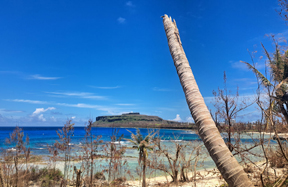
On our approach to the tiny airport there, the devastation was all too evident. It appeared to me that every leaf on every tree—the trees still standing anyway—had been blown out to sea. The entire island, covered with lush green jungle only days before, now looked more like the hills of Arizona than the tropical paradise it had been.
But while the island may have been broken, with devastated tropical forests, washed out roads and a power distribution system in tatters, the people of Rota were decidedly not broken. Typhoons are a part of life there and always have been.
Milt Allen, the Red Cross man in charge there and my driver from the airport to the staff shelter in Sinapalo, gave me the rundown on the situation at the staff shelter. “There’s no place to sleep,” he warned. “We’ve got probably 15 people living in a three-bedroom house.”
He was right. Space was at a premium there and nearly all the sleeping space, including most of the floor, had already been claimed by one or another of my compadres. The lucky ones got cots or even beds. The rest slept wherever they could.
Over the course of that week, I slept on the roof, on the hard tile kitchen floor, under the dining room table and at least one night in a car.
The first two nights I slept on a cot in the carport with the neighbor’s generator blaring a few feet away all night long like a John Deere riding mower at full throttle. On both of those nights, I was rudely awakened at 3 a.m. by passing rain and thunder squalls that blew far enough into the carport to soak my blankets and I. My only recourse was to retreat to the tiles on the kitchen floor or sit up with my back to the wall, hiding from the deluge as much as possible.
The week I spent on Rota was an eventful one. Besides configuring and maintaining the Starlink systems and generators at the various shelters, I got to participate in a food distribution event in conjunction with another couple of disaster relief agencies, and I participated in three different cash assistance programs in both Songsong and Sinapalo.
The food distribution event took place in Songsong and involved a caravan of several vehicles passing out bags of groceries, tarps and buckets of cleaning supplies to the locals. Since elders are treated with great respect in that society, the high school kids doing most of the heavy lifting refused to let me carry anything, so I made it my business to at least tag along in the 90-degree heat with 90 percent humidity to show my face and my Red Cross vest to the recipients of the items.
I had been warned ahead of time that the locals would at every opportunity be offering me food, and they were right. We had a number of Saipanese Red Cross volunteers staying with us at the staff shelter and they were always making sure we were fed. “Jimbo, have you had breakfast yet?” and “Jimbo, it’s dinner time! Esta oran chumochu! It’s time to eat!”
The Saipanese did most of the cooking, so we were presented nightly with tasty culinary concoctions from that region that included pork, chicken or fish served with different variations of rice dishes. Local repasts like kadon pika (spicy stewed chicken with white rice) were common and there was always a big bowl of delicious boiled yams out on the kitchen counter.
Rota shares something else in common with Catalina. Deer were introduced there about a century ago, in Rota’s case by the Spanish. As a consequence, venison is also part of the local cuisine. Hunting rules are pretty lax there compared to California and one day someone’s uncle went out and shot us a buck, so we were treated that evening to marinated and skillet-fried venison steaks, served with fried rice and yams.
On July 23, with my three-week deployment fulfilled, I left Rota for Guam on a charter flight on Micronesia Air Cargo Services, or MACS. Two days later I retraced my steps back through Honolulu to Los Angeles, leaving behind a distant chain of islands still reeling from disaster, all along knowing that sooner or later another typhoon will be sure to pay them a visit.