
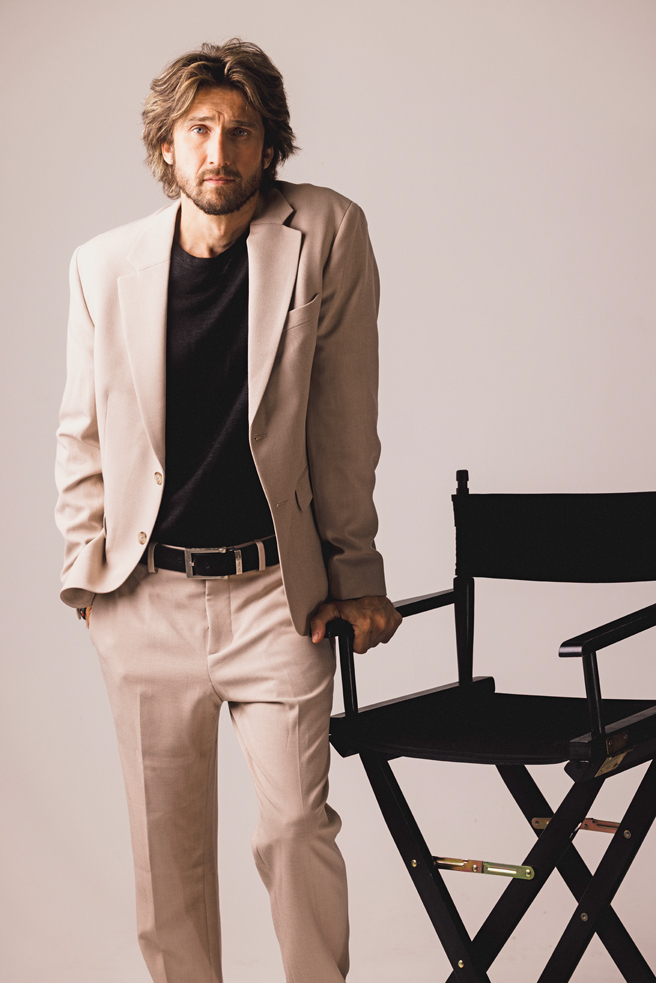
Among the films coming to the Catalina Film Festival in late September, award-winning filmmaker, writer, and actor Landon Ashworth is bringing his most personal and affecting work yet with his directorial debut with the feature film “Go On.”
Landon, a 2e gifted autistic storyteller and former test pilot, wrote “Go On” while processing the loss of his young autistic cousin to suicide. The film also stars Vincent Kartheiser (Mad Men) and Laura Slade Wiggins (Shameless) alongside Ashwoth (Space Force)
Off-screen, Landon built an audience of nearly three million social followers by turning “rejected” commercial pitches into viral comedy sketches, demonstrating his ability to turn obstacles into opportunity. A well-known voice in the autism community who’s amassed millions of social media followers from his sketch comedy, Ashworth won multiple screenwriting festivals last year with a TV pilot surrounding the women bra-makers of the ’50s and ’60s who improbably won the contract to build NASA’s Apollo spacesuits.
Ashworth is no stranger to topics about space, having earned a PhD in astrophysics and spent three years as a test pilot for the National Oceanic and Atmospheric Administration. As an actor, Ashworth has been seen in the Will Ferrell comedy “Land of the Lost,” as well as such series as “The Resident,” “MacGruber,” “Space Force,” and “NCIS”.
Synopsis of Go On
Set in a burned-out wilderness that feels both familiar and otherworldly, Go On follows Jim, a man bound by isolating routines in a strange purgatory, until an unexpected visitor disrupts his solitude. As Jim forms an uneasy connection with Zac, the film slowly reveals itself as a meditation on grief, healing, and the quiet, transformative power of human connection. Their uneasy connection slowly reveals the true nature of the place they inhabit: a kind of purgatory for the lost and grieving. As Jim wrestles with solitude, regret, and the meaning of connection, he must decide whether to remain trapped in isolation or embrace the vulnerability it takes to move on.
Ashworth recently took time to share some insight of his film and his experiences in filmmaking with the Islander.
The Catalina Film Festival will be on Catalina, Sept. 26-28. Go On is scheduled to show on Sept. 27, at 1:30 p.m.
Q&A
CI: How would you say working on Go On helped you with the healing or catharsis, if any, of the personal loss with which you were dealing?
Ashworth: Just days after spending a week with me, my cousin Landon Bellm took his own life. That experience didn’t so much ‘inspire’ Go On as it forced me to confront grief in its rawest, most destabilizing form. I don’t cry easily—I grew up as a bullied autistic kid, and somewhere along the way I converted tears into inquiry. Pain, for me, has always become a question: What does it mean to push on? What does it mean to move forward when the weight of loss can derail?
Go On became the container for those questions. I didn’t approach it as catharsis—I don’t think cinema resolves grief. Instead, I treated it as a mirror: a way of seeing what is unbearable made visible, structured, and, in some sense, livable. I’m not kept awake at night because I feel unhealed; I’m kept awake because I wonder if I captured the right fragments of him, if I honored his life in a way that transcends my own mourning. The film gave me as many new questions as it offered moments of stillness.
Ultimately, I think cinema’s highest function is not closure but resonance. I can’t know if Landon would be proud of the film, but I hope the work carries the same unresolved beauty and ache that defined him.
CI: Who are some of the writers and filmmakers who have had an influence on your work or maybe the way you approach writing and filmmaking?
Ashworth: I’ve always been wary of influence. In comedy, you learn quickly that a joke you heard 10 years ago can reappear in your writing, and suddenly you don’t know if you created it or absorbed it. That terrified me. So, I stopped watching almost everything—not out of disdain, but out of self-preservation. My brain tends to fixate and recycle, so rather than risk imitation, I’ve tried to create in a vacuum.
That discipline has made my work idiosyncratic, because it comes only from lived experience, not cinematic reference. Professors loved to say, ‘There are no original ideas,’ but I’ve always resisted that. There’s an entire universe of possibilities if you stop recycling and start excavating what only your mind can produce. I’ve been told my whole life that my brain works differently; I chose to lean into that. Sometimes it pulls me into the light, sometimes into the dark, but always into something uniquely my own.
If my work feels different, it’s because it doesn’t aspire to resemble anyone else’s—it comes from shutting off the echo chamber and listening to the silence where new ideas live.
CI: Is there a part of the process you enjoy most (writing, acting, directing, etc.)?
Ashworth: My favorite moment is when the work is finally complete—when the noise of production fades and I can step back, look at the film as a whole, and measure what I’ve built. During writing or directing, it’s easy to get trapped inside the mechanics, but I’ve learned to keep my eyes on the full picture. I knew I’d never be able to out-network neurotypicals, so I made a motto: make my own art, never wait to be invited into someone else’s. That became my north star.
I wasn’t given opportunities, so I created them. That meant learning a new discipline anytime I was cast on a TV show—writing, fundraising, casting, contracts, producing, acting, directing, editing, even color and sound. For a decade, I had no choice but to do it all. At first, it was survival; now it’s muscle memory. I thrive in that multi-tasking environment because of my previous life as a jet pilot, where you learn that fifty things can go wrong at once and you still have to land the plane.
So, for me, the joy isn’t just in writing or acting or directing in isolation. It’s in arriving at picture lock, seeing how every decision aligns into a single organism, and asking: Did I make something true? Did all those moving parts come together into something larger than the sum of its jobs? That final moment of perspective is what I live for.
CI: People with autism can be challenged in many different ways (academically, socially, life skills, etc.). Would you be willing to share some of the things in life you’ve found most challenging to deal with due to autism?
Ashworth: Social dynamics have always been the hardest part of being autistic. Academically and creatively, I thrive—I can outwork anyone, I turn assignments in early, and my perspective is unique. But in rooms where success depends on charm or hierarchy, I can falter. I tend to overshare, give too much context, or focus on the obstacles rather than the triumphs.
When I applied for the NBCUniversal Diversity Writers Program, I made it to the top 50 out of more than 2,000 applicants based on my script alone. In the interviews, when asked what made me stand out, I said exactly what I believe: that autistic writers deliver relentless precision, fresh perspective, and an efficiency you don’t have to ask for twice. The head of the program told me I was one of the hardest-working applicants—but that he couldn’t move me forward because I might ‘get in my own way’ socially and they needed writers who could ‘fall in line.’
That was devastating, because the very thing that makes me unique—my work ethic, my refusal to coast—was seen as a liability. But I’ve come to realize that’s also what makes my filmmaking different. I may not flourish in every social context, but on the page and on screen, my work does. And in the end, that’s where I want my voice to live.