

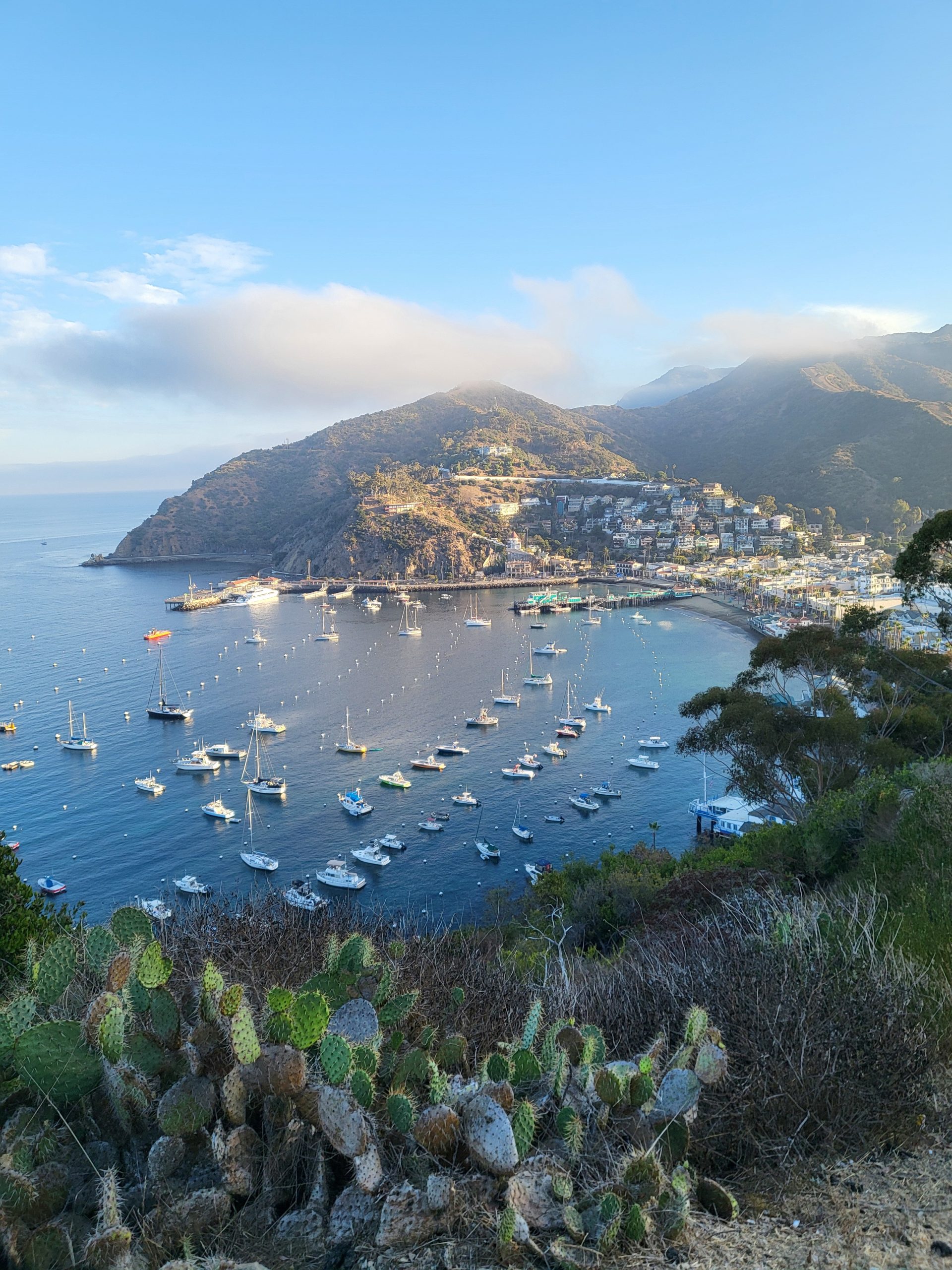
A few weeks ago I either astounded you or bored you silly with the etymology (origins) of several of the place names in California and on Catalina Island. We looked at the origins of place names from Salta Verde to Mt. Orizaba and then some.
Well, it’s time to put your thinking caps back on and travel back in time with me nearly a thousand years to the first usages of the word “avalon”: who used it and why they used it.
A few weeks ago I either astounded you or bored you silly with the etymology (origins) of several of the place names in California and on Catalina Island. We looked at the origins of place names from Salta Verde to Mt. Orizaba and then some.
Well, it’s time to put your thinking caps back on and travel back in time with me nearly a thousand years to the first usages of the word “avalon”: who used it and why they used it.
Those with a cursory understanding of Catalina’s history know that the name “Avalon” was bestowed upon the Paris of Catalina by the sister-in-law of town founder George Shatto. Previously, names like “Shattoville” and “Shatto-town” had been bandied about as contenders. But fears that the town might one day become a rowdy seaport (thus tarnishing the Shatto name) put the kibosh on that.
Another, less potentially controversial name was sought and Shatto’s sister-in-law Etta Whitney pulled the name “Avalon” from Lord Alfred Tennyson’s poem “Idylls of the King.”
That much you probably already knew or at least should have known if you’ve spent any amount of time here. But where did Lord Tennyson get the name? And from where did that source get the name and the source before that? Where was the name first spoken or upon whose parchment was it first inscribed?
Since this column is about the origins of the word, let’s cut right to the chase: Apples. The original word “avalon” is believed to be derived from the Welsh word for apple, namely “afal”. This word is the root of the word “affalon” which loosely translates to “of the apples.” The Latin spelling of “affalon” would be “Avallonis,” which gets us much closer to the modern spelling.
It was in the legends of King Arthur that reference to an “Island of Apples” is first made. The legendary “Insulis Avallonis” first appears in Geoffrey of Monmouth’s “Historia Regum Britanniae” as the place where King Arthur’s legendary sword Excalibur was forged. Later, King Arthur himself was taken to the “Island of Avalon” to recuperate from wounds suffered in the Battle of Camlann.
Things get a little more interesting in Monmouth’s “Vita Merlini,” or “The Life of Merlin.” Merlin the Seer or Merlin the Magician should need no introduction to anyone familiar with Arthurian legend.
Merlin was one of the residents of this “Avalon” along with another mysterious character from Arthurian legend named Morgan Le Fay. Miss le Fay was the leader of nine sorceress/enchantress sisters who lived on the island. By some accounts, le Fay was an ally of Arthur’s, but appears in later accounts as an antagonist to him and to the Knights of the Round Table in general.
But it wasn’t just the inhabitants of Avalon who possessed magical powers. According to Monmouth, the Island itself was magical (sound familiar?).
In Geoffrey’s own words: “The Island of Apples (Avalon), which men call ‘the Fortunate Isle,’ gets its name from the fact that it produces all things of itself; the fields there have no need of the ploughs of the farmers and all cultivation is lacking except what nature provides.”
Interesting.
“The ground of its own accord produces everything instead of merely grass, and people live there a hundred years or more.”
An interesting twist occurred in real life in the year 1190 when monks at the Glastonbury Abbey claimed to have found the bones of King Arthur and his queen Guinevere.
Up to this point, Avalon had been considered a fictional land. But once these supposed remains were found, the monks got it in their heads that, just maybe, they were standing on the site of the long lost Island of Avalon.
(At this time, Glastonbury was not an island, but it had historically been surrounded by marshland. This marshy fen had since been drained, so it was not out of the question that the monks felt they might be standing on a former island).
The remains of King Arthur and Guinevere were reinterred at the Abbey. The headstone that was placed over them reads (in Latin): “Here lies entombed the renowned King Arthur in the island of Avalon.”
While this sounds romantic, the authenticity of this find has been questioned by historical and archaeological experts. To some, it was a fraud perpetrated to raise funds to repair the Abbey after it had been nearly destroyed by fire in 1184. Unsatisfied by this possible example of pseudo-archaeology, others have searched for the legendary island of Avalon for centuries, creating an air about the island not unlike that which surrounds Atlantis or Shangri-La.
Of course, those of us living on Catalina long ago discovered the truly magical place known as Avalon, where all manner of apples can be found in the Produce section of Vons.
Editor’s Note: Jim Watson is the author of “Mysterious Island: Catalina,” available on Amazon, Kindle and in stores in Avalon.