

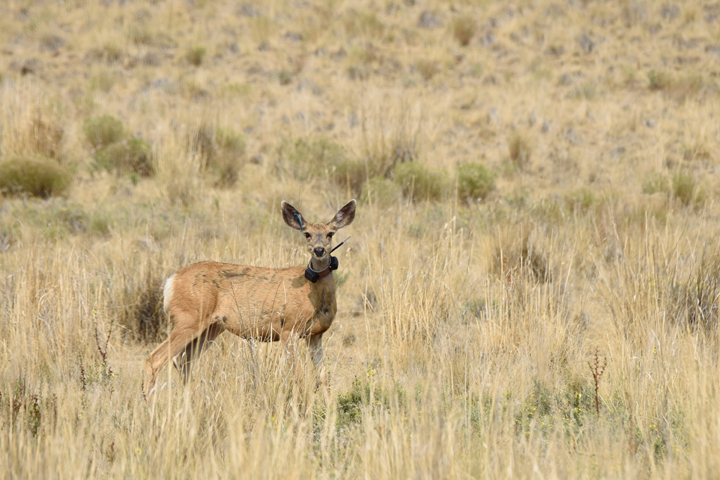
Now that the Catalina Island Conservancy is armed with a permit to move forward with its deer eradication plan, Fourth District Supervisor Janice Hahn has not backed away from her demand for some deer to remain on the Island and, indeed, has ratcheted up her campaign by asking the L.A. County’s legal counsel to step into the fray.
In a letter to the Conservancy from the office of Los Angeles County legal counsel Dawyn R. Harrison this week, the county is demanding an immediate “stay” on the permit approval awarded by the California Department of Fish and Wildlife.
If granted, a “stay” would temporarily halt the project until court proceedings could determine if special conditions, imposed by the petitioner, should be included.
“The Office of the County Counsel represents the County of Los Angeles (County) in all legal matters. We are writing to voice our firm opposition to the approved Resource Management Permit (RMP) authorizing the total eradication of mule deer on Santa Catalina Island,” the letter said.
“We demand an immediate stay of this RMP based on the unnecessarily violent methodology, the disregard for critical wildfire safety, and the questionable judgment exercised by the Catalina Island Conservancy (Conservancy) in its management approach,” the legal counsel’s letter continued.
“First, the proposed methods of utilizing aerial net capture, nocturnal ground shooting with drone support, and hunting dogs over a five-year period are inhumane and deeply distressing,” the letter said.
“The RMP clearly contemplates humane sterilization as an appropriate mechanism to control the mule deer population. However, it is unconscionable that the Conservancy has relegated non-lethal humane sterilization to a secondary consideration. Sterilization must be elevated to a primary management tool,” it suggested.
Moreover, the formal letter opposing the Catalina Island Conservancy’s plan to systematically shoot and kill the entire deer population on Catalina Island calls the plan “a direct threat to human life.”
“Third, this plan is a direct threat to human life,” the county’s office of legal counsel said in the letter.
Los Angeles County Fire Chief Anthony C. Marrone has explicitly warned that the total removal of these grazers will cause an unmanaged surge in “fine fuels,” directly increasing the wildfire danger to the City of Avalon and the Island’s critical infrastructure.
In addition to the position of Fire Chief, Marrone also serves as the county’s Forester and Fire Warden.
“By ignoring the County Fire Department’s professional assessment, the Conservancy and California Department of Fish and Wildlife (CDFW) are prioritizing plant life over the safety of human residents,” it said.
Pepe Barton, a spokesperson for the Conservancy, told the Islander that “the Counsel is citing the Fire Chief’s letter as evidence that deer removal poses a direct threat to public safety, and the memo does not say that.”
“The Los Angeles County Counsel’s recent letter challenging the Catalina Island Conservancy’s restoration project is based on factually incorrect information that is not rooted in science and furthers misconceptions about the realities on Catalina Island,” said Barton, confirming a letter has been sent to the county countering the Legal Counsel’s charge.
“The suggestion that removing invasive mule deer endangers human life is simply false. Protecting human lives, property, and livelihoods is a core component of the project. Wildfire and conservation experts agree removing invasive deer will make the Island more resilient to wildfire, not less,” the Conservancy said in the letter.
“The Fire Chief’s memo says no such thing. Instead, the Chief notes that invasive deer are having a devastating impact on the Island and that if they are fully removed, a fuels management program should accompany that work,” the Conservancy responded.
“We completely agree with the fire chief on how the deer are impacting the island, but the science also shows that deer directly create conditions that lead to more frequent wildfires on Catalina,” said Barton in an interview after the exchange of letters.
He claims the Fire Chief believes that after the deer are removed, the Conservancy must maintain a program that promotes the growth of native chaparral (plants and shrubs), which are less conducive to wildfires than the invasive grasses that will grow once the deer eat the chaparral.
“We don’t want a fire on Catalina every year,” he said.
“Operation Protect Catalina Island is a forward-facing resiliency project that will foster climate adaptation for the Island and its community. Non-native species have concerningly accelerated a conversion of Catalina Island’s landscape towards a monocrop of quick-burning fuels that accelerate fire activity,” said Evie Vermeer, wildfire planning specialist.
“This proactive project will help restore ecosystem functions while decreasing the wildfire hazard for Catalina Island,” she says in the statement sent to L.A. County officials.
A copy of Marrone’s memo to Hahn was attached to the County Counsel’s joint letter to the Conservancy and the California Department of Fish and Wildlife.
Barton is apparently correct that Marrone’s memo does not mention any specific threats to the Island’s population, yet it does suggest the best strategy would be keep some deer on the Island.
“Both ecological integrity and wildfire risk must be considered in mule deer management decisions. An actively managed population provides the most balanced approach, limiting long-term vegetation type conversions while helping moderate fuel loading in proximity to communities,” Marrone’s memo said.
“If the mule deer is fully removed, additional long-term costs would be incurred to implement and maintain a comprehensive fuels management program, particularly adjacent to the developed areas. Active population management represents a lower-cost alternative with measurable (fire) risk reduction benefits,” it concluded.
“Based on these considerations, it is recommended that land managers determine an appropriate ecological balance through actively managed mule deer population,” Marrone’s Jan. 5 memo concluded.
In addition, his memo claims “population regulation should focus on minimizing types of conversion and long-term habitat change, with particular emphasis on removing female does as the most effective population management strategy.”
“If a decision is made to remove all mule deer from the island, a comprehensive fuels management program should be implemented, especially in areas adjacent to development and human occupancy,” the Fire Chief concluded.
Liz Odendahl, Hahn’s Communications Director, said late Wednesday that the County had indeed sent the letter to the Conservancy and had received their response.
Odendahl said Hahn remains steadfast in her belief that Marrone’s memo indicates that the Island would remain safer with a small, “manageable” herd of deer, not completely removing them.
“With the fire chief weighing in, she (Hahn) now thinks that it is critically important that they (Conservancy) take his warning seriously,” she said.
“They should consider allowing a small herd to continue living on the island for fuel management because that would be safer for island residents,” the spokesperson said.
“They’ve (Conservancy) been very resistant to moderating their plan, but she (Hahn) is going to keep asking,” said Odendahl.
“The Supervisor, and residents, believe that the herd was allowed to grow too large, but a small herd, of a manageable number, can act to clear brush and make the lives of our fire fighters easier and make the community of Catalina, who love the deer, much happier as well,” she said.
Barton said the Conservancy will continue the dialogue with Islanders and governmental agencies involved. “We have always worked to be transparent and provide these opportunities for the community.”
No one at the California Department of Fish and Wildlife was immediately available for comment.