

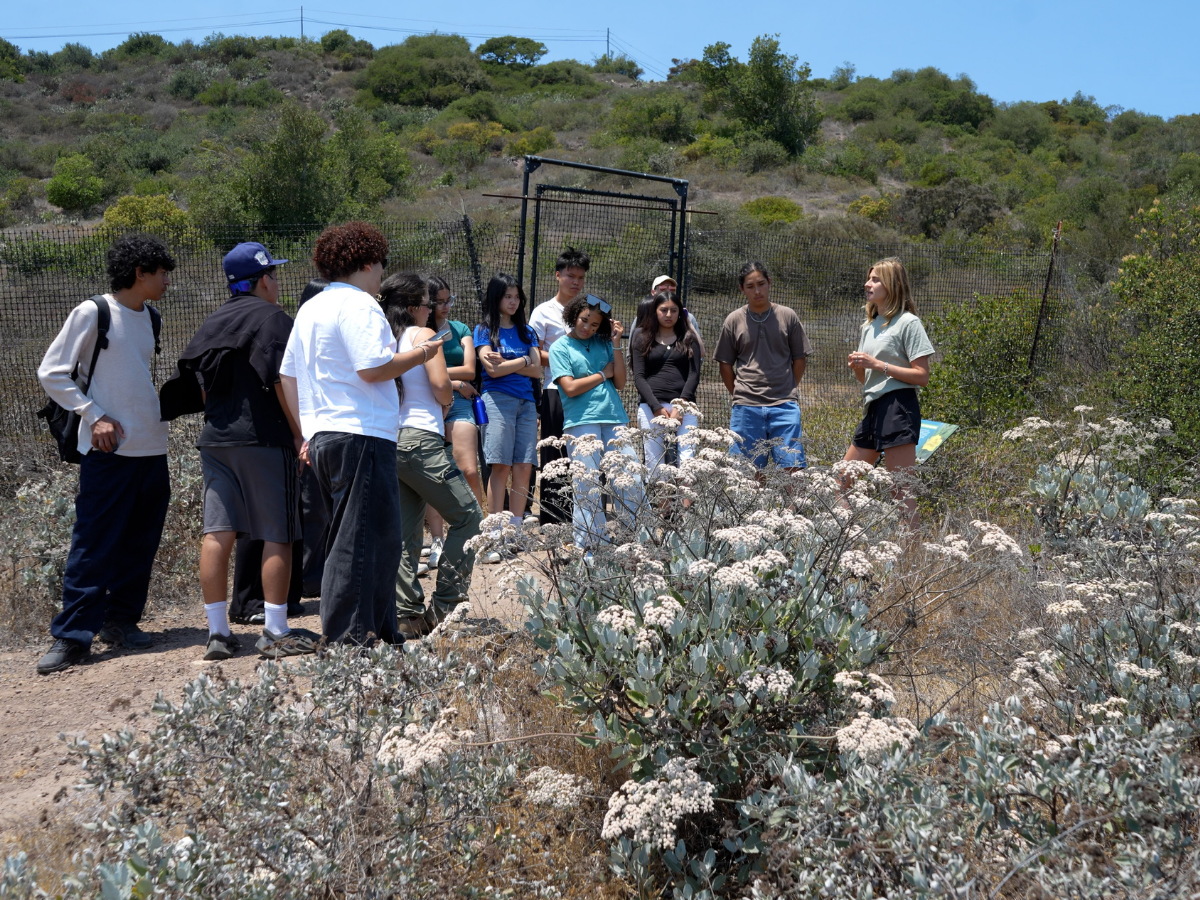
LA Conservancy students get lesson in conservation
Courtesy of Catalina Island Conservancy
Looking up from beneath towering trees at the Catalina Island Restoration Area, students considered the answer to the question they’d just been asked. “How many individual Ironwood trees do you think this is?” asked Senior Naturalist Alex Brainerd from inside the enclosure, which was constructed by the Conservancy to demonstrate natural regrowth of native plants following wildfire without the threat of browsing by invasive deer.
The teenagers murmured guesses among themselves before one brave student offered a number. “Is it just one?”
“That’s right, it’s a trick question,” said Brainerd, as the boy who answered beamed with pride.
The group of students may have been new to the Island, but they were already familiar with some aspects of its vegetation. As members of the Heritage Project, a program by the Los Angeles Conservancy for high school students, these young visitors were in the middle of a three-week-long summer experience about conservation and how it relates to their own personal histories.
“A lot of these kids have never been to Catalina before, so to them, it’s a really new experience to get to experience an island like this off the coast of California, especially an area that’s so undeveloped and has so many acres of wildlands to get to experience nature,” added Brainerd.
“For many, this is their first experience camping, hiking, being outside for more than an hour at a time, just being in nature and connecting to this story of history is pretty rare,” said Sarah Lann, LA Conservancy Director of Education.
Looking forward to the camping at Two Harbors that was planned for later that night, Michael Tan, 17, was excited.
“Of course, it’s scary for the first time to go camping but so far it’s pretty fun,” said Tan.
Oliver Jimenez, 15, was no stranger to the outdoors but said visiting Catalina felt special.
“It’s really like stepping into a whole other world,” he said. “It’s interesting because we get to go into a lot of places where, like if you’re a regular tourist going to Catalina, you’ll probably just stay in Avalon. But here it’s completely unique and you get a whole new sense of nature and it totally reshapes your understanding of the world around you.”
After observing the plants at the restoration area, the students traveled to Airport in the Sky for lunch before stopping at the soap stone quarry. This archaeologically significant place has cultural value to the Gabrieleno-Tongva people, who inhabited the Island for thousands of years before colonization, and continue as important partners to the Conservancy.
“We bring them here so they can get a sense for what was here before the built environment, to connect to Indigenous and Tongva history, native plants and animals that are specific to Catalina,” said Lann.
“The Channel Islands have a really deeply rooted human history of thousands and thousands of years of cohabitation of humans and the landscape, so sharing that history as well as significance of the Tongva – the people who are Indigenous to Catalina – is really important,” said Brainerd.
As the threats of climate change persist, students like Jiminez are eager to experience the Island and understand its delicate ecosystem.
“To see them now is really good and to grow a connection helps you understand why we need to protect and conserve these areas,” said Jimenez.
And though conservation is front of mind for many students on this visit, not all of them are envisioning a future career in conservation. Lann said that’s the point. Conservation is everyone’s responsibility, regardless of their title.
“Our goal is really not to make them into the next historic preservationist – if they want to, great,” she said. “But a lot of them are really interested in architecture or urban planning or marketing or business or the environment and we think there’s a way you can become a good steward of the place you live through all those different channels.”
For Brainerd, whose work within the Conservancy’s education department aims to introduce and inspire people of all ages to think about protecting their environment, early access and exposure is key.
“In this time of the world, it’s really important to educate the youth about preserving natural spaces and stewarding lands because the more people get involved with that work, the better we can cohabitate with the planet,” she said.
The Conservancy regularly hosts students and school groups of all ages on the Island for immersive experiences, whether that’s educational programming or volunteerism. As Los Angeles County’s largest outdoor classroom, the Island serves as a space for cultivating curiosity among students to foster a love for the outdoors and an understanding of conservation. Children from underserved communities are given meaningful access to the interior, where they learn about native plants, wildlife and environmental restoration.
About the Conservancy
Founded in 1972, the Catalina Island Conservancy is one of California’s oldest land trusts. Its mission is to be a responsible steward of its lands through a balance of conservation, education and recreation. Through its ongoing efforts, the Conservancy protects the natural and cultural heritage of Santa Catalina Island, stewarding approximately 42,000 acres of land and more than 62 miles of rugged shoreline. It provides access to the Island’s wildlands and 50 miles of biking and nearly 165 miles of hiking opportunities within its road and trail system. The Island is home to 60 species, and counting, that are found only on Catalina. For additional information, please visit catalinaconservancy.org.