

With the ironic opening of what could be the last deer-hunting season on Catalina Island coming Oct. 24, the Catalina Island Conservancy announced this week that it will begin its own hunting season, suggesting its long-debated deer eradication program will officially begin in September.
While there is no opposition to the actual hunting season, opposition remains strong to the eradication plan as a coalition of islanders and wildlife groups, along with the city of Avalon, can now only look to the courts for relief.
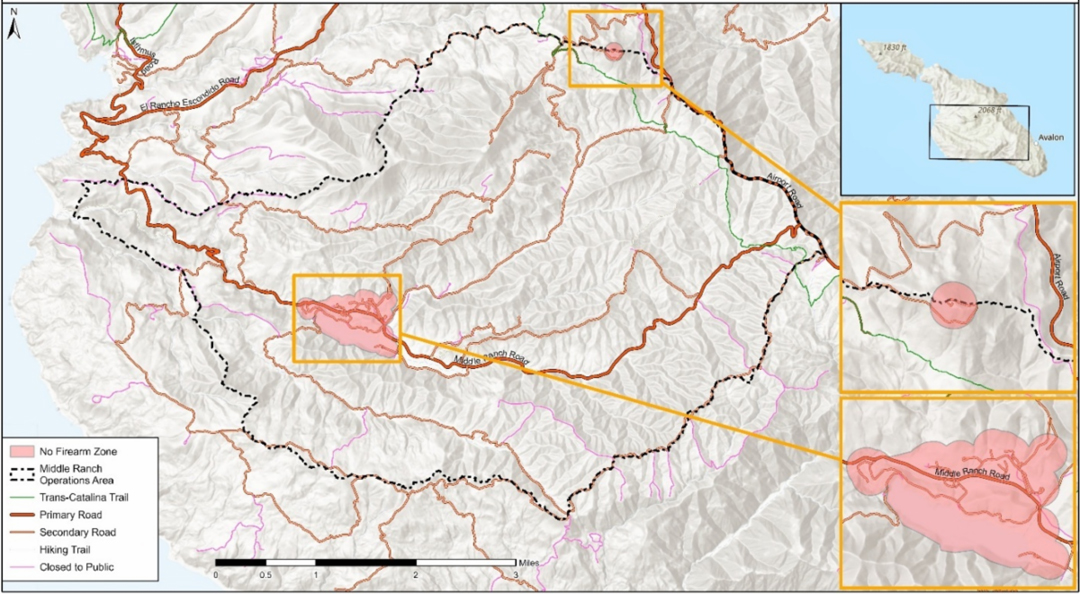
“The Catalina Island Conservancy will conduct invasive mule deer removal operations in the Middle Ranch area from September through October 2026,” the Conservancy said in a statement released this week.
“Trained wildlife management professionals will carry out the work under a permit issued by the California Department of Fish and Wildlife. The operations are one part of Operation Protect Catalina Island, the Conservancy’s coordinated plan to restore native habitat, protect rare and threatened species and reduce wildfire risk,” the Conservancy said.
The Conservancy says its deer eradication operation will take place primarily during evening and overnight hours, beginning 90 minutes before sunset and continuing until 90 minutes after sunrise. Hiking and biking access will be suspended in affected areas during those hours. Daytime access will remain available unless otherwise posted.
“Licensed professionals will use firearms, air rifles and tranquilizers with extra tools to safely see deer in the dark. Firearms will not be used within 150 yards of buildings,” the Conservancy claimed in the statement.
“Visitors may encounter field crews, vehicles, temporary signs and barriers. Follow all posted signage and closures, remain on open roads and trails, and do not enter closed areas during operation hours. Keep pets leashed and give crews space to work safely,” the Conservancy said in a statement.
Chuck Michel, a Long Beach attorney coordinating a coalition of interest groups opposed to the deer eradication, confirmed they have scheduled a court hearing that will hopefully result in a temporary injunction against the Conservancy’s plan.
Michel, on behalf of Safari International and a coalition of aligned interests, has filed a lawsuit seeking to halt the Catalina Island Conservancy’s planned eradication, and the City of Avalon has filed a statement citing legal concerns of its own in support of the coalition’s central arguments.
The suit may become moot if a judge refuses to halt the plan.
Therefore, opponents argue in court briefs that a new state law, authored by a central California representative and ultimately signed into law, authorizes streamlined pathways to approval for restoration projects like the one proposed by the Conservancy.
In his brief, Michel said such pathways are questionable and could cause harm.
“The Project’s questionable legality under CEQA (California Environmental Quality Act) and its approval of RMP (Restoration Management Permit) pursuant to the SERP (Statutory Exemption for Restoration Projects), avoiding robust stakeholder and scientific review, and meaningful coordination with agencies such as the Commission, the State Water Board, the Regional Board, and other relevant regulatory agencies, local governmental municipalities, and fire authorities, underscores that no comprehensive regulatory review has occurred,” said the Michel brief.
“Accordingly, without such input and oversight, the Project is at risk of harming the local ecosystem, including inland and coastal waters, flora, and fauna, as well as human health and safety,” it said.
A letter from Scott H. Campbell of Best Best and Krieger on behalf of the city of Avalon, claims the Conservancy’s project constitutes a development in the coastal zone for which a coastal development permit is required.
“The project’s activities will involve a fundamental transformation of land on Santa Catalina Island, including through its mule deer extraction, habitat manipulation, vegetation removal and replacement, and extensive herbicide application,” Campbell’s letter states.
“As substantial changes in the use of land and natural animals and materials are contemplated, these activities render the project a ‘development,’ for which a coastal permit is required,” it continued.
They are asking the court to initiate an enforcement investigation of the Conservancy’s project, determine whether the project constitutes an unpermitted development, issue a cease-and-desist order as appropriate, and require a coastal development permit before further activity.
The state, in briefs filed by the state’s Attorney General Rob Bonta and a host of Assistant Attorneys General, including one on behalf of California Fish and Wildlife, it is claimed that the new state law in question is valid.
“Petitioners’ arguments ignore the fact that the Legislature enacted a statutory exemption from CEQA for environmental restoration projects like the one at issue here,” says the legal answer filed by the Attorney General’s office.
“The Department completed all the necessary steps to determine that the Project qualified for the CEQA exemption for such restoration projects. As an exempt project, public notice and comment or additional CEQA documentation, such as an Environmental Impact Report or Negative Declaration, are not required,” the brief contends.
“Further, based on the exhibits provided in the SAP, there was a robust public process surrounding the Conservancy’s development of the Project, and Petitioners were well aware of the Project and voiced their objections in various venues,” it continues.
“In addition to the balance of harms and probability of success on the merits both weighing heavily in Respondent’s favor, the purported urgency of Petitioners’ ex parte application is a result of Petitioners’ own actions. Petitioners waited until July 27, 2026, nearly six months after the Department issued the RMP (Restoration Management Permit) to the Conservancy, before filing their motion for preliminary injunction requesting the Court to halt specific actions related to the Project,” the state claimed in its Superior Court brief.
“Petitioners have failed to show either a likelihood of success on the merits, or that the balance of harms, including the public interest, weigh in favor of the Court issuing a TRO to enjoin implementation of the Project until the Court can hear Petitioners’ motion for preliminary injunction…should be denied,” the state claims.
Nevertheless, Michel said while Superior Court Judge Curtis A. Kin denied the Temporary Restraining Order, he did so to accelerate a hearing date to Sept. 1 on the Preliminary Injunction to halt the Conservancy’s plan.
The Long Beach attorney said the case will be heard on that date, but Judge Kin may not have an immediate ruling. He said the Conservancy has “represented to us” that they would honor the Sept. 1 date regarding the case, meaning they would wait until the hearing.
Pepe Barton, the Conservancy’s Communications director, said they were aware of the hearing and said the deer eradication program would generally move forward as planned. He did not say, however, that the program would begin exactly on Sept. 1, saying the timeline established in the permit was “September through October.”
“Unless we hear otherwise from the legal proceedings, the Conservancy plans to move forward with the timeline previously established,” he said.