

Avalon does not have enough revenue to keep up with the cost of the saltwater system, according to a city consultant.
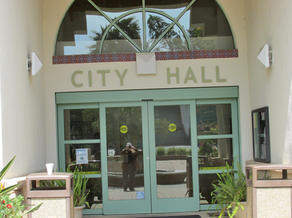
This week Josiah Close, the utility rates project manager with HDR Engineering Inc., gave the City Council an overview of the rate study for the city’s sewer, saltwater and solid waste services.
The presentation included the initial findings from the rate study.
The council took no action on the matter on March 3. Finance Director Matt Baker said staff would come back to a future meeting for the council to set the public hearing date.
Baker described the March 3 presentation as informational.
The following is not a transcript by highlights from the presentation.
Project Manager Close said HDR Engineering Inc. did the rate study in 2021.
Close said the purpose of the study was to recover the cost of the service to customers
“When we look at the costs, we’re primarily looking and operations and maintenance expenses,” Close said.
“We also want to consider the capital infrastructure replacement that we need to do on the system to make sure that they’re all running reliably for when customers need to use those services,” Close said.
Part of the study, according to Close, is meeting the requirements of Prop. 218, an amendment to the California Constitution.
“On general, the intent of Proposition 218 is to ensure that all taxes and most charges on property owners are subject to voter approval,” according to the California Legislative Analyst’s Office.
According Close, the hearing will be held at least 45 days after notices go out to property owners. Protests, if any, will be tallied. If there are fewer than 50% plus one protests, the council is allowed if they choose to adopt the rate study.
“We’re trying to ultimately fairly charge each customer based on how they impact uh the systems,” Close said.
According to Close, HDR Engineering goes through industry manuals to determine how customers impact the local systems.
“When we look at those manuals, it helps us to create a repeatable uh rate study that’s conducted in a similar manner as rate studies that are conducted across the state and across the country,” Close said.
Close said they also wanted to consider financial planning for such things as reserves on hand for cash flow and emergencies.
Close described a three step process for the rate study: The required revenue, the cost of service, and the rate design.
The idea, according to Close is to distribute the cost among the customers for each utility.
“We took the 2025-26 budgets as the baseline for the study and for each utility we then escalate costs into the future based on inflationary factors so that we can make sure that we’re keeping up with that escalation of costs over the 5-year period,” Close said.
Saltwater
According to close, the prior study didn’t have the details needed for renewal and replacement of the saltwater system.
“As we have developed those projects and seen what the needs are within the system, we’re able to update that,” Close said.
To calculate future costs, they started with the current budget and inflate with the following years to keep up with costs.
According to Close, the target for reserves is enough money to cover 180 days of operations and maintenance costs.
Rates—Saltwater
According to a table from Close’s slide presentation, the proposed residential saltwater rates would be $329.15 in 2026-27, $360.40 in 2027-28, $394.65 in 2028-29, $432.15 in 2029-39, and $473.20 in 2030-31.
Rates—Sewer
“We’re just below that 180 day target in sewer,” Close said.
Proposed residential sewer rates are $1,201.75 for 2026-27, $1,315.90 for 2027-28, $1,440.90 for 2029-30, $1,527.35 $1,619 for 2030-31.
Public showers, businesses, hotels, churches, bars, restaurants and take-out restaurants would also see sewer rate changes.
Rates—Solid waste
The proposed solid waste rates are $969.95 for 2026-27, $1,013.60 for 2027-28, $1,059.20 for 2028-29, $1,106.85 for 2029-30, and $1,156.65 for 2030-31
Overall
“So when we look at the three utilities in total for residential customers, we’re showing about a 7 12% increase per year for three years and then about a 6% for the last two years,” Close said.